Based on the concept of “Every drop counts” Warka Water designed by the architect Arturo Vittori is eliminating people’s thirst in arid lands, where people are forced to consume u…
The Ishu Scarf, invented by a 28-year-old guy, Saif Siddiqui, from New Delhi, is gaining popularity amongst the cynosures.
Celebrities around the world are bothered about their privacy and here’s a solution from this New Delhi student, who now runs his booming business due to his innovative product and creative talent. The name “ISHU” stands for privacy and silence, and is a play on the words “issue” and “shh”.
Everyone from Hollywood actors to football superstars are being spotted the Ishu scarf in public.
Image credit: Buzzfeed
Siddiqui told Buzzfeed the scarf’s purpose was to give people their privacy.
“The main intention is to make people aware of how important privacy actually is,” he said. “Everyone has a ‘brand’ online, and with the ISHU Scarf, people are back in control of their privacy.”
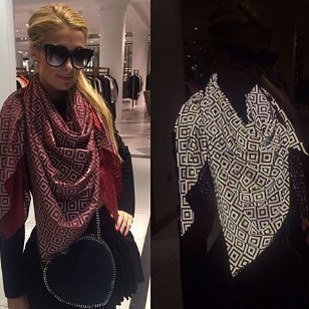
Presenting… the paparazzi-proof ISHU Scarf!
Image Credit: theishu.com | Jillionaire “Major Lazer” DJ and Producer
Image Credit: theishu.com | DMX, The Rapper
Image Credit: theishu.com | Cameron Diaz, Actress
Image Credit: theishu.com | Jemery Piven, Actor
The Ishu scarf made from a special fabric – consisting of thousands of nano-spherical crystals reflects light back into the camera and hence makes the wearer invisible to the flash photography.
The ISHU was officially launched at Soho House Toronto in October 2015. The force behind the creation of this #InvisibilityCloak was adamant that a stylish solution be available to that select group of people who want to control unwanted pictures of them being taken with mobile devices, which inevitably end up plastered across social media.
Image Credit: theishu.com | Saif Siddiqui, founder of theishu.com now runs his booming business shuttling between London and Amsterdam.
It took Saif 6 years to research and present his idea into a demanding product. We often see the success but fail to see the hard work, dedication and belief in one’s idea and his continuous efforts to make his idea successful. Here’s the making of “The ISHU Scarf”:
The concept of The ISHU dates back to 2009 when Dutch-born Saif Siddiqui took a picture of friends standing in front of a bike in Amsterdam. He noticed that the bike’s reflector manipulated the flash of his mobile camera in a way that obscured the faces of his friends in the picture. He immediately realized that if developed into the right product, this feature would be an ideal solution for his friends and now available to the public who want to keep their private moments in public private. Saif put together a team of experts
who dug into the science of light and reflection, and how to blend technology with fashion. 6 Years later The ISHU is released to instant acclaim. Privacy is back.
The “anti-paparazzi” cloaking device also works with video cameras.
Siddiqui is launching ISHU phone cases in July, and hopes to get the product integrated in museums and private jets soon.
He aims to bring the concept to India in a few months, and is hopeful that it will catch the eye in Bollywood as strongly as it has in the rest of the world.
Image credit: Hindustan Times
You can check out the ISHU range of products before the global launch in August here.
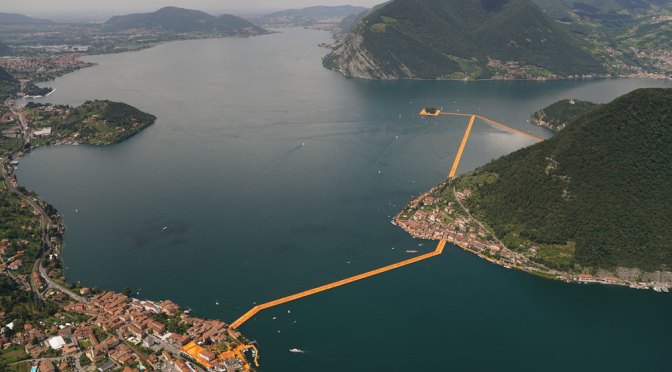
“The Floating Piers” is a giant art installation by the artist Christo on Lake Iseo in Italy which is enabling people walk on water.
Have an aerial view of “The Floating Piers” here:
So far thousands of tourist have flocked over the installation. The walkway is 100,000 square meters of shimmering yellow fabric, made up of 220,000 high density polyethylene cubes and is about 3 miles long. The installation is open for the public at large till 3rd of July.
Visitors can experience this work of art by walking on it from Sulzano to Monte Isola and to the island of San Paolo, which is framed by The Floating Piers.
The Floating Piers is absolutely free and accessible 24 hours a day, weather permitting,” said Christo.
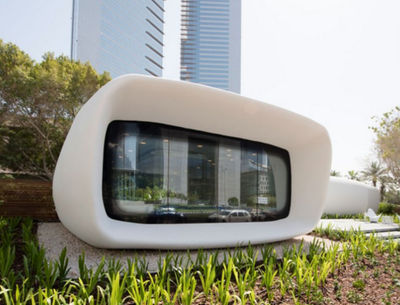
The world’s first functional 3D-printed office building, a single storey building spread across 2,690 square foot, opened in Dubai in mid of May, 2016.
Located near the Dubai International Financial Center, the building was completed at a cost of about $140,000 in just 17 days and officials say they saved more than 70% on labor costs.
Dubai officials say their goal is towards technological development. It’s already a man-made wonder you will know once you visit Dubai.
This arc-shaped office building used a 20-foot tall 3D printer and a special mixture of cement to be built. Whole of the office structure with furniture was printed in 17 days and assembled in just 2 days.
Dubai officials say, “The future is based on 3D printing, whether we are talking about printing buildings or printing cloths or printing equipments or printing food or even printing some human body parts.”
The project is part of Dubai’s long term strategy to ensure that 25% of the city will be 3D printed by 2030.
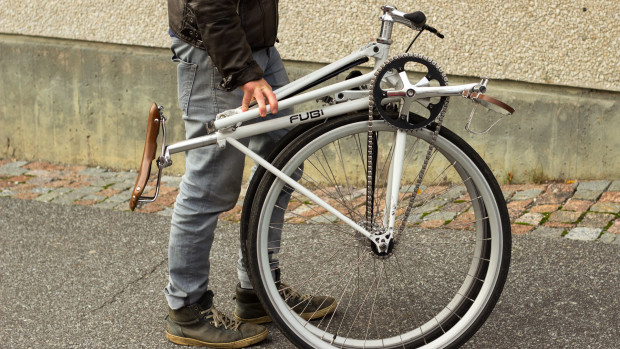
FUBi Fixie is a single speed one gear bike, which can fold itself without any tools. It looks like a classic bike which can be fit in a closet or a trunk. It weights 24 pounds and is selling on Indiegogo at $535.
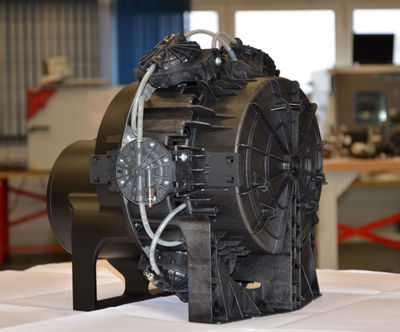
French firm Cooltech Applications has launched what it claims as the world’s first commercially available magnetic refrigeration system. It can serve as a “Superfridge” slashing down both the environmental as well as economic challenges which the current electricity appliances face.
The Magnetic Refrigeration System (MRS) achieves refrigeration by passing a water coolant through magnetocaloric materials undergoing repeated magnetization-demagnetization cycles. Glycol water is used as a coolant fluid to transfer heat between cold and hot sources.The system works on the concept of magnetocaloric effect.
The system works without any refrigerant gas, making it more environmentally efficient than conventional refrigerators.
Designed in collaboration between Fendi and botanical-wizard Azuma Makoto, this pop-up flower shop is the cutest thing on 3 wheels. The piece was created to promote the 2016 Spring/Summer Collection by Fendi, which has a theme all about flower power. Naturally, the company sought Makoto’s expertise, as he is one of the most talented floral artists in the world today.
The installation was built on an “Ape,” a vehicle produced by the Italian carmaker Piaggio and designed by the inventor of the Vespa. Originally it was created to aid the struggling citizens in post-war Italy. Today, it stands in the Ginza Flagship store, completely covered in flora.





























































 CA Shivani Gupta